

I get a lot of questions about the Alaska Airlines companion fare provided each year you pay the annual fee on your Bank of American Alaska Airlines Visa Signature Card. Sometimes people come up with ideas that don’t make any sense to me, but then I’m usually a pretty straightforward guy when booking tickets. Feel free to be more creative. I’m used to it.
On the other hand, I have tried enough test cases that I’m getting pretty good at predicting what will and will not work. So here’s my guide to everything I know about the companion fare.
How to Use the Alaska Companion Fare: Basic Rules
You can use the companion fare for just about any ticket involving travel on Alaska Airlines or Horizon Air.
One way, round trip, open jaw, multi-city, whatever. You can use the companion fare for any ticket so long as there are no codeshares or partner flights. If you can book it without a companion fare–and all the segments are on Alaska or Horizon–then you can also book it with a companion fare. There are very few routing rules, which 99% of people will not encounter. I’ll get to that in a minute.
You need to book economy class.
A few years ago, Alaska removed the ability to use the companion fare on first class tickets. Some people think this was a huge blow. However, I find that upgrades are pretty easy to obtain.
Update: As of late 2018, I’m no longer as confident that upgrades are easy to come by. They seem less frequent, and eligible fares are fewer. In particular, some flights operated by Virgin America’s Airbus fleet have very few first class seats that are almost never available for upgrades. You might consider settling for Alaska’s new premium economy instead, which still offers extra legroom and complimentary alcohol.
The companion fare is just a discount code.
The companion gets an ordinary ticket booked into an ordinary fare class, just like the primary traveler. The companion just pays less. Unlike most companion fares issued by airlines or credit card issuers, there are no blackout dates or special restrictions you need to worry about. There only need to be two tickets available.
The bad news is that this means you can’t combine the companion fare with other discounts, such as customer care credits or birthday specials.
All the usual rules apply.
On your receipt, you can see the fare class purchased. If I booked a Y fare, then my companion will have a Y fare. If I booked a G fare, then my companion will have a G fare. It doesn’t matter that the companion paid less. Upgrades, changes, cancellations, and earning miles are all possible like with any other ticket. The companion is simply getting the same ticket as you for a lower price.
Advanced Alaska Companion Fare Rules
You don’t need to book round-trip.
Although the terms and conditions say the fare must be for round-trip travel, this isn’t strictly true. You can book one-way travel. You can book open jaws. You can book multi-city travel between completely different cities. I’ve confirmed that Austin to Seattle, Portland to Maui, and Honolulu to Sacramento, all on different dates, will qualify.
If you want to build in stopovers, you can book AUS-SEA//SEA-OGG//OGG-SEA//SEA-AUS all on different dates. (Although I wouldn’t really call this a stopover. It’s four one-way fares booked on a single ticket.)
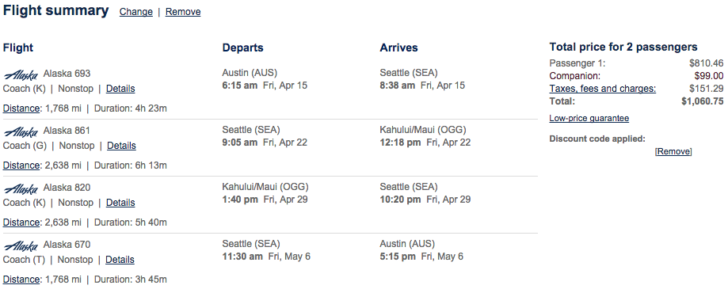
Remember, you don’t have to enter the segments exactly as you fly them. Alaska only offers four segments in its multi-city search tool, which can be constraining. Use these wisely to force a stopover, but otherwise let the search engine find connecting cities on its own. You could enter AUS-PDX as one segment to force a stopover in PDX and pick a result that includes a connection (not a stopover) in Seattle.
What you can’t do is book travel that is clearly not anything close to round-trip. In the example of AUS-SEA//PDX-OGG//HNL-SMF we flew west and then flew east. Kinda sorta maybe round-trip, even if we never hit the same city twice.
For an ordinary ticket, you can use the multi-city search tool to book something bizarre like AUS-SEA//SEA-OGG//AUS-PDX, flying west twice in the same ticket. However, trying to apply a companion fare to this itinerary will return an error.

You can book any fare class within the economy cabin.
You can book G, L, K, Y, B, M, or any other fare class. Keep this in mind if you want to upgrade as upgrade rules vary with the fare class you purchase. The companion will still pay $99. If the difference between the cheapest fare and an upgrade-eligible fare is $50, then only the primary traveler needs to pay it. The companion still pays $99.
You can change your ticket as much as you want.
If you change your mind you can change your reservation to completely different cities and dates while keeping the companion fare intact. You can also re-fare your ticket into a more expensive fare class that makes you eligible for an upgrade. I screw this up all the time and often book cheap fares that are ineligible for instant upgrades, so I have to call back (or go online), and pay an extra $10 or $20 to become eligible for a Gold Guest Upgrade or instant MVP Gold upgrade.
You cannot cancel your ticket without losing the companion fare.
Alaska has a pretty generous cancellation policy. MVP Gold and 75K elite members can change their ticket at any time without penalty. (This benefit does not carry over to non-elite and regular MVP members in the same reservation; they need to pay $125.) However, canceling a ticket will lose the companion fare discount. I strongly recommend you change the ticket instead. The same fees apply either way. Because my wife and I are both MVP Gold members, if we don’t know when we’re going to use it, we will change the ticket to something fare out in the future and change it again when we make up our mind. You can do this, too, without status as long as you get a large enough discount to make up for the change fees.
I once used a companion fare to go to Dallas, changed my mind, and rebooked it to San Francisco for some far out date. San Francisco is cheap, so the extra funds went into MyWallet. Then when I decided what I was going to do I rebooked it for Maui and took those funds right back out of MyWallet to pay the difference since Hawaii is more expensive.
Even More Companion Fare Rules and Tricks
You can get more than one companion fare.
My wife and I each have several companion fares because we each have several Alaska Airlines credit cards. We currently get four per year. I know friends who get more, but this is enough for me. You might want to consider staggering your card applications so you get the companion fares at different times.
The success of this approach has changed over time. Bank of America implemented the so-called “2/3/4 rule” in 2017. That limits approvals to two cards every two months, two cards every 12 months, and four cards every 24 months. It’s pretty manageable (one card every six months is still pretty good), but others have reported more difficulty getting approved as of early 2019.
You don’t need to be the primary traveler.
In general, you do need to be on the reservation if you’re using your companion fare, but you don’t need to be the primary traveler. We almost always try to make me the primary traveler when my wife and I travel together. This is because I almost never cancel a trip, while sometimes things do happen in her life. If the primary traveler doesn’t show up at the airport, the companion won’t be allowed to fly. You’ll be able to choose who is the primary traveler and who is the companion when you get to the passenger information page.

You don’t need to book through your account.
The system is smart enough to tell if you’re on the reservation even if you aren’t logged in through your account. If I want to use the MyWallet funds I have left over from a low fare guarantee or a canceled trip, we need to book through my account (or her account if she has the MyWallet funds). We can still use my wife’s companion fare. I first log into her account, retrieve the coupon, and then log into my account. The coupon is just a code that you can enter when beginning a search.
You don’t even need to travel at all.
If you aren’t going to be on this trip, you can still redeem your companion fare for two other people as long as you’re the one who pays for it. This also makes it easier to redeem multiple companion fares if you are traveling with a family. Just remember you’ll need to make separate reservations, and it’s probably smart to pair up children with adults.
For example, I recently moved to Austin (as of 2018) and don’t get to fly Alaska Airlines as much as I would like. I still use them for trips back to Seattle, to see my family in California, and for our annual vacation in Hawaii. But I could also use my companion fares for my sister and her boyfriend to visit us, or for my sister and brother in law to join us in Hawaii.
Still Reading?
You can use the companion’s Gold Guest Upgrade codes.
This last bit is getting off-tangent, but I do like to redeem Gold Guest Upgrades when redeeming a companion fare. If we book the trip while logged into my account, I’ve already explained that we can still use my wife’s companion fare (assuming she’s traveling) and choose either person as the primary traveler.
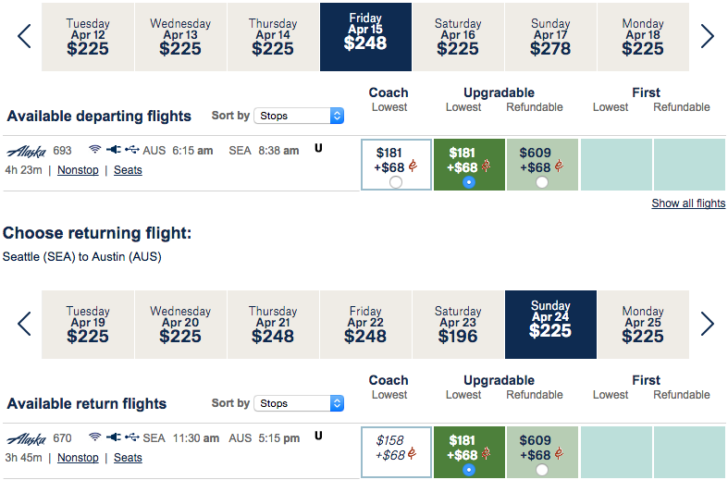
Whose account you’re logged into only really matters for accessing MyWallet funds and applying Gold Guest Upgrades.
You don’t have to use your own Gold Guest Upgrades. At the end of the reservation, after paying, it will ask if you want to apply a Gold Guest Upgrade. Say “yes” but don’t select any segments to upgrade. Keep the confirmation number, log out, log into your companion’s account, and add the reservation using the last name and confirmation number. You should be able to make a new Gold Guest Upgrade request using the companion’s upgrade codes.
Discount: Valid for one annual Companion Fare from $121 (USD) ($99 base fare plus taxes and fees from $22 depending on your Alaska Airlines flight itinerary) when traveling with another passenger on a paid airfare. Valid for coach class only. Both passengers must be booked in the same itinerary, at the same fare, traveling together, and ticketed at the same time. Valid for round-trip or one-way travel. Multiple stopovers not allowed. Valid on published fares. Valid on published fares. Not applicable to Mileage Plan Award Reservations, Alaska Airlines Vacation packages, tour or contract fares.
Reservations & Ticketing: Valid for new ticket purchases through alaskaair.com or EasyBiz. The Companion Fare Discount Code is redeemed at time of ticketing and is void for future changes or purchases. Traveler and/or Purchaser name must match the name issued on the Discount Code. Credit card required for purchase.
Passengers: Valid for one Companion Fare when traveling with a second passenger on a paid fare, traveling together, and booked and ticketed at the same time in the same reservation.
Routes: Valid systemwide.
Advance Purchase: Per applicable fare rule.
Purchase By: Expiration date on Discount Code.
Blackout Dates: Per applicable fare rule.
Minimum & Maximum Stay: Per applicable fare rules.
Flights: Valid only on flights operated by Alaska Airlines and flights operated on behalf of Alaska Airlines by Sky West and Pen Air. Not valid on codeshare flights.
Taxes, Fees and Surcharges: Passenger is responsible for all applicable taxes, fees, and surcharges, including checked baggage fees.
Combinability: Not valid with any other discounts, including Discount Codes, My Account online discount, coupons, discount programs, or other arrangements.
Changes and Refunds: Changes and refunds are allowed per the applicable fare rule and may result in the forfeiture of the Discount Code.
Mileage Plan: Mileage Plan credit applies and upgrades are allowed.
Transferability: Discount Codes and tickets are not transferable. They may not be given to another individual, and may not be sold, bought, bartered, auctioned or collected in bulk. Any deemed by Alaska Airlines to have been distributed or acquired improperly will not be honored and traveler will be liable for payment of full fare.
Additional Terms: All rules of Alaska Airlines , alaskaair.com, and the applicable fare rules not mentioned within these terms and conditions apply.
Other: Lost or stolen Discount Codes or tickets cannot be replaced. Alaska Airlines has the final authority regarding redemption. Travel is subject to Alaska Airlines contract of carriage. Terms and conditions as written herein are final and cannot be changed by any statement or representation of any unauthorized person, including employees of Alaska Airlines or issuing organization. Other restrictions may apply and Alaska Airlines reserves the right to suspend or change this offer without notice.
2026 Update: The Atmos Rewards Rebrand and What Changed
The information above reflects how the companion fare worked under the original Alaska Airlines Mileage Plan and Bank of America card program. In 2025 and 2026, Alaska and Hawaiian completed their loyalty program merger, combining Mileage Plan and HawaiianMiles into a single program called Atmos Rewards. The companion fare benefit now travels with the new co-brand cards under the Atmos Rewards umbrella.
The most meaningful change for travelers: the fare is now usable on both Alaska-operated and Hawaiian-operated flights within North America. The core mechanics (economy only, discount code, no blackout dates, no codeshare eligibility) remain the same. What changed is the card names, the program name, and the eligible network. The cards that currently carry the companion fare benefit are the Atmos Rewards Ascent Visa Signature and the Atmos Rewards Visa Signature Business Card. If you held an older Alaska Airlines co-brand card, check with your card issuer for current benefit terms, as conversion timelines have varied.
How Much Does the Alaska Companion Fare Cost?
The companion fare is not free travel. Understanding the actual cost upfront helps set realistic expectations and makes it easier to evaluate whether a given redemption makes sense.
The base fare for the companion seat is $99. On top of that, both travelers pay government-imposed taxes and carrier-imposed fees, which start from $23 for a straightforward domestic round-trip. That puts the realistic all-in floor at roughly $122 for a round trip, and that number rises with route distance, particularly for flights to Hawaii where certain fees are higher.
Crucially, the companion portion cannot be paid with Atmos Rewards miles or any other points currency. It is a cash transaction. The primary traveler pays the full published fare, and the companion pays $99 plus applicable taxes and fees. So the actual savings depend entirely on what the primary fare costs: a $600 round-trip to Maui generates far more value than a $150 West Coast hop.
Quick Annual Fee Math
The Atmos Rewards Ascent Visa Signature carries an annual fee. Even a single redemption on a mid-range route will typically offset that fee outright, since the companion seat on a Hawaii itinerary might otherwise cost several hundred dollars at the same fare class. Travelers who fly Alaska or Hawaiian at least once a year with a companion will generally find it straightforward to justify the card on this benefit alone.
How to Earn the Companion Fare Each Year
There are two ways to hold a companion fare certificate. New cardholders receive one as part of the welcome offer, typically after meeting a minimum spend threshold in the first few months. The ongoing annual fare is separate: to earn a renewed certificate each anniversary year, cardholders must spend $6,000 on the card within that year. Once that threshold is crossed, the certificate is issued.
Each card earns one certificate per year. Two cards in a household can therefore generate two certificates annually, which is the approach described earlier in this guide. Staggering application dates, if both people in a household want to apply, spaces out when the certificates arrive throughout the year rather than having them expire at the same time.
At-a-Glance: Companion Fare Quick Reference
| Detail | Current Info |
|---|---|
| Companion base fare | $99 |
| Typical taxes and fees | From $23 (varies by route) |
| Realistic all-in cost | About $122 round-trip and up |
| Cabin | Economy only at booking (upgradeable afterward) |
| Eligible airlines | Alaska and Hawaiian flights within North America |
| Where to book | alaskaair.com only |
| Cards that earn it | Atmos Rewards Ascent Visa Signature; Atmos Rewards Visa Signature Business Card |
| Annual spend to renew | $6,000 per anniversary year |
| Can you pay with points? | No, companion portion is cash only |
| Codeshare/partner flights | Not eligible |
Is the Alaska Companion Fare Worth It?
For travelers who regularly fly Alaska or Hawaiian with a companion, the answer is almost certainly yes. A single Hawaii redemption on the companion fare will typically offset the Atmos Rewards Ascent card’s annual fee entirely, with meaningful value left over. The west-coast-to-Hawaii traveler is the clearest beneficiary: Hawaii fares are high enough that the $99 companion seat represents hundreds of dollars in savings on routes that most Alaska cardholders are already inclined to fly.
The fare earns its keep even on shorter routes, as long as the primary fare is high enough to generate real savings. A $300 round-trip to Seattle with a companion pays you back well over the annual fee. Where it becomes a harder case is for travelers who rarely fly the Alaska or Hawaiian network, or who cannot reliably hit the $6,000 annual spend threshold to renew the certificate. Forcing spend onto a card you wouldn’t otherwise use just to earn the fare may not come out ahead.
The other factor worth considering is flexibility. Unlike many airline companion passes, this one has no blackout dates, works across a fairly broad network now that Hawaiian flights are included, and allows the creative booking approaches described above. That flexibility makes it genuinely useful, not just theoretically valuable.
Frequently Asked Questions
How Much Does the Alaska Companion Fare Cost?
The companion base fare is $99 plus taxes and fees that start from $23, so the realistic all-in cost is about $122 for a round trip and rises with distance. The companion portion cannot be paid with points or miles.
Can I Use the Alaska Companion Fare on Hawaiian Airlines Flights?
Yes. Since the Atmos Rewards program merger, the fare applies to both Alaska-operated and Hawaiian-operated flights within North America, as long as the booking is made through alaskaair.com. Codeshare and partner-operated segments remain ineligible regardless of which carrier’s ticket stock they appear on.
Does My Companion Have to Travel With Me?
Generally, the primary cardholder needs to be on the reservation and pay for the ticket, but does not have to be the primary traveler. As described above, it is also possible to redeem the certificate for two other people traveling together, as long as the cardholder is the one making and paying for the reservation.
Can I Use the Companion Fare for a First Class Ticket?
No. The companion fare requires an economy class booking. However, the resulting ticket is treated like any standard economy ticket, which means it can be upgraded after booking through the usual upgrade mechanisms available to Atmos Rewards elite members.
How Do I Earn the Companion Fare Each Year?
New cardholders receive a certificate as part of the welcome offer. For ongoing annual certificates, the card requires $6,000 in purchases within each anniversary year. Once that threshold is met, the certificate is issued and is typically valid for one year from the date of issuance.
Should I Change or Cancel a Companion Fare Booking?
Changing is generally the safer move. Per Alaska’s own policy, an unexpired companion fare code is redeposited with its original expiration date when a ticket is canceled, while an expired code is forfeited on cancellation. Changing the reservation to new dates or cities sidesteps any re-issuance and expiration risk and keeps the certificate working for you, which is why it is the practical default covered in detail above.