A jet carrying Libya’s top general crashed after takeoff in Turkey, briefly closing Ankara’s airspace and exposing how fragile high-level travel can be.
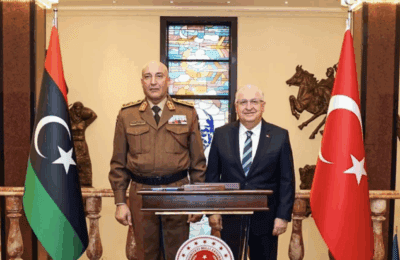
Crash Kills Key Military Personnel for Libyan Army
On December 23, a Dassault Falcon 50 departing Ankara crashed shortly after takeoff, killing everyone onboard, including Libya’s army chief of staff, Mohammed Ali Ahmed Al-Haddad. The aircraft reportedly declared an emergency and attempted to return to the airport before contact was lost. Turkish authorities later said the crew reported an electrical failure.
“The prime minister of Libya’s U.N.-recognised Government of National Unity, Abdulhamid Dbeibah, said he had received news of the death of Libya’s army chief of staff after Al-Haddad’s plane lost radio contact above Turkey’s Ankara” – Foxnews
Here’s the flightpath of the aircraft which crashed 11 minutes after signaling the aircraft was in trouble.
According to Flightradar24 data, the Falcon 50 private jet carrying Libya’s Chief of General Staff accelerated and climbed to 32,000 feet before squawking 7700 (emergency) at 20:33 local time. CCTV footage shows the aircraft crashing 11 minutes later. pic.twitter.com/b6TJl1UpeG
— Mintel World (@mintelworld) December 23, 2025
Routine Departure Became a Capital-level Emergency
From a purely aviation perspective, the early facts are unremarkable in the worst possible way. A small jet. A post-departure emergency. An attempted return. A crash before the runway ever comes back into view. These are the moments every flight crew trains for and hopes never to experience. This is also the second immediate return to the departure airport resulting in a crash in recent weeks.
What changed everything was who was onboard and where the aircraft went down.
The location, Ankara, Turkey, is also a key piece to this tragedy. It is a NATO capital, a political nerve center, and a place where uncertainty is treated aggressively. Within hours of the crash, airspace over Ankara was temporarily shut down and flights were diverted while authorities secured the area and assessed the situation.
That decision alone signifies the concern around the incident. Airspace closures are disruptive, expensive, and politically sensitive. Governments do not do them lightly. They do them when the unknowns outweigh the inconvenience.
Effects From The Crash
There is a temptation to immediately ask whether something more sinister was at play, especially given the proximity to several sensitive areas. As of now, there is no public evidence to support foul play. All credible reporting points to an onboard emergency and a technical failure. Investigations take time, and speculation fills gaps faster than facts ever will.
But even without foul play, the implications are significant.
• Libya lost its top military officer in a single moment.
• Turkey found itself managing an aviation emergency over its capital.
• Airlines and passengers were reminded that diversions and delays can happen instantly, for reasons completely unrelated to weather or congestion.
This is the uncomfortable reality of aviation. The same system that moves tourists, business travelers, and families around the world also moves heads of state, generals, and diplomats. When something goes wrong on those flights, the consequences scale up immediately.
Conclusion
This crash was not just an aviation accident, and it was not just a political shock. It was a reminder that air travel sits at the intersection of technology, risk, and power. When something breaks at that intersection, the effects travel faster than the aircraft ever could. Ankara’s brief airspace shutdown, Libya’s sudden military loss, and the global attention that followed all stemmed from a single departure that never became a flight. Our thoughts are with the family of those affected by this tragedy.