For nearly a decade, American Airlines insisted that seatback screens were yesterday’s technology. Why install expensive entertainment systems when everyone carries a smartphone, tablet, or laptop? TV Screens are dead on short haul flight, that was the way of US Airways management that took over American Airlines and TVs were dead
This week, the airline quietly admitted what many travelers have been saying for years: passengers still want seatback screens. And not just in business class. American announced that every seat on its narrowbody fleet will eventually get a modern entertainment screen, along with more premium seating, upgraded cabins, and Starlink Wi-Fi.
For frequent flyers, this is one of the most significant product announcements American has made in years. Now they will play catch up with Jetblue, Delta, and United. Leaving only low cost carriers and Alaska Airlines without seatback entertainment.
The Great Entertainment Experiment Failed
Back in 2017, American began removing or eliminating seatback entertainment across much of its domestic fleet. The airline argued that personal devices had replaced the need for built-in screens. Meanwhile, Delta and United continued investing heavily in onboard entertainment.
At the time, the logic seemed reasonable. Almost everyone carries a phone, a kindle, or some type of tablet. Many travelers bring tablets to watch movies or laptops. Screens add weight, maintenance costs, and complexity. But there was one problem: passengers never really stopped liking seatback entertainment. When it’s there, it’s watched and it’s requested more than anything.
A phone screen is fine for a short flight between say Seattle and Portland. It’s a different story on a five or six-hour transcontinental flight. Most travelers would rather watch a movie on a large screen than strain their eyes on a device they’ve already been using all day.
Families particularly felt the pain. Parents know that built-in entertainment can be the difference between an enjoyable flight and several hours of managing bored children and dead batteries. Plus not all kids have their own tablets or phones.
American spent years telling customers that streaming content to personal devices was the future. Now it is spending what is likely a substantial amount of money to reverse course. And we know the timeline will be slow. AA does nothing quickly.
What’s Changing
American’s new plan is ambitious. Beginning with new Airbus and Boeing aircraft deliveries in 2028 and extending to retrofitted aircraft, every seat on the airline’s narrowbody fleet will eventually receive a seatback screen. The airline says the displays will be among the largest available on narrowbody aircraft in North America. Features will include 4K resolution, Bluetooth audio connectivity, USB-C charging, interactive flight maps, and personalized content recommendations.
That alone is great news. But this is not an overnight change. It will take a few years and AA will take several years to catch up with the other major airlines in North America. American is pairing the entertainment upgrade with something even more important: more premium seats.
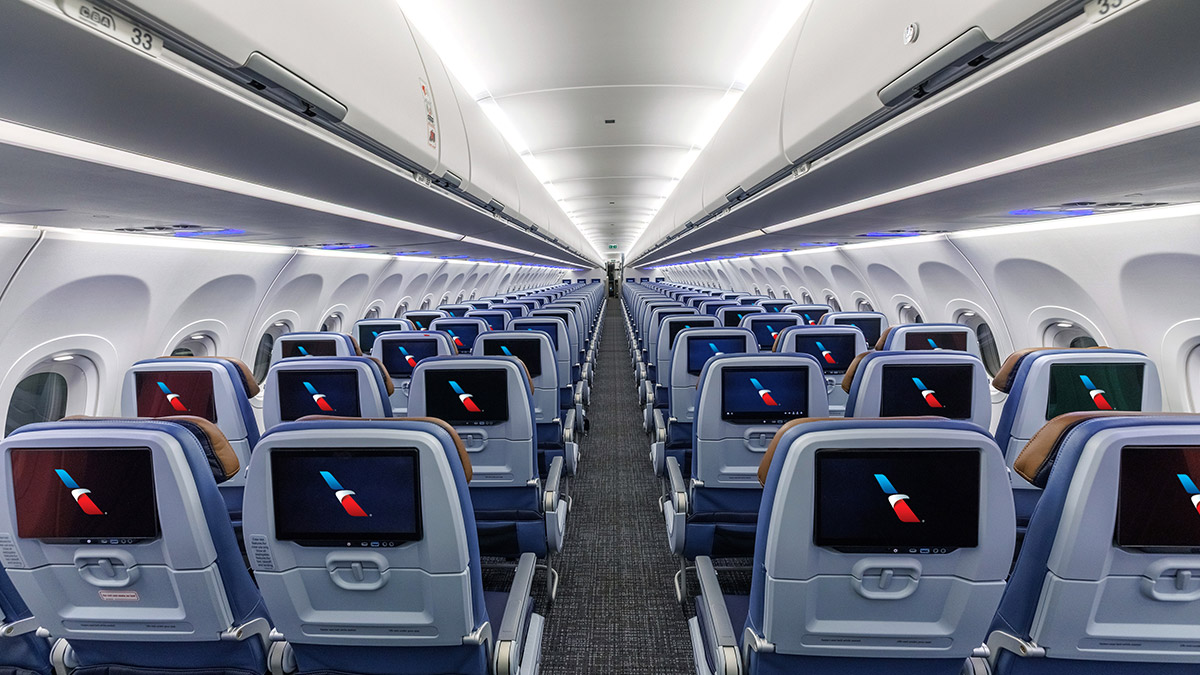
Today, approximately 25% of seats on American’s narrowbody departures are considered premium. The airline plans to increase that figure to roughly 40% over time! Since covid people want more space and customers are willing to pay to sit up front with more legroom and perks.
The changes include:
- Additional First Class seats on Airbus A319 and A320 aircraft
- 24 First Class seats on future Boeing 737 MAX 10 deliveries
- More Main Cabin Extra seating throughout the fleet
- Redesigned cabin interiors with increased storage and updated lighting
For elite members and travelers who regularly pay for extra legroom, this may actually be the bigger story. This could mean more upgrades. Yet if the economy of space stays the same, expect those seats to sell, not go to Elites .
My Take
As someone who flies regularly, I think American is making the right decision, even if it’s nearly a decade late. The competitive pressure is real and American Airlines is folding to the competition. American Airlines wants to be a premium airline, therefore they need to start acting like it.
Airlines sometimes become so focused on efficiency metrics and cost savings that they lose sight of what passengers actually value. Seatback screens were never just about watching movies. They provide a more comfortable, intuitive, and premium travel experience. That’s especially true as fares continue to climb and airlines push customers toward higher-priced premium products.
The irony is that American is now spending years and likely hundreds of millions of dollars restoring something it deliberately removed. But travelers aren’t going to complain. Stockholders might.
The airline deserves credit for recognizing the mistake and correcting it. The real test will be execution. New aircraft start arriving with screens in 2028, but retrofitting hundreds of existing aircraft will take years, with completion not expected until the early 2030s.By then will we still want them?
For now, American passengers finally have something they’ve wanted for a long time: proof that the airline is serious about improving the onboard experience, not just talking about it. And perhaps the biggest lesson from all of this is one the airline industry has learned repeatedly over the years.
Sometimes the newest technology isn’t replacing something travelers love. Sometimes it’s enhancing it.