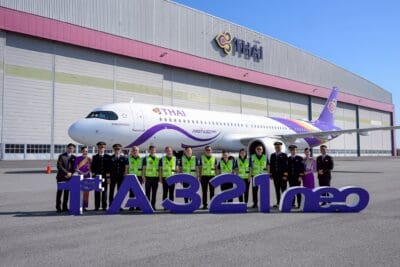
Thai’s Airbus A321 neo puts sixteen lie-flat seats on Bangkok–Singapore, then points to longer India routes where premium comfort finally makes real sense.
A New Narrowbody, And A Familiar Shift In How Airlines Think
Thai Airways’ first Airbus A321neo is entering service with a cabin that would have felt excessive on a narrowbody not that long ago. Today, it feels almost inevitable. Airlines keep discovering that the A321 family is not just about right-sizing capacity, it is about right-sizing ambition. With the right interior, these jets can reshape how short and medium-haul routes are marketed, priced, and perceived.
The configuration Thai has chosen tells you exactly what kind of aircraft this is meant to be. Sixteen fully lie-flat seats in the forward cabin, modern high-resolution seatback screens throughout, and satellite connectivity built in from day one. This is not a domestic-style narrowbody being pressed into regional service. It is a premium tool designed to compete head-on with widebodies on select routes, and with other carriers that are also leaning into high-end narrowbody flying.
Bangkok–Singapore Is Short, But Thai Is Treating It Like A Flagship
Thai plans to debut the A321neo on the core Bangkok–Singapore rotation, one of Southeast Asia’s most competitive trunk routes. Flight time clocks in at roughly two hours and twenty minutes gate-to-gate, depending on winds and schedules. That makes the decision to install sixteen lie-flat seats feel almost provocative.
Yet this is exactly how the longest fuselage of the A320 family keeps changing the game. On a route where frequency is high and fares can be commoditized, product suddenly becomes a differentiator again. A flat bed on a short sector is not about sleeping. It is about signaling. It tells corporate travelers and premium leisure flyers that this flight matters, that this cabin is consistent with what they might expect on much longer journeys, and that Thai is not conceding ground to competitors on one of its most visible regional markets.
Once one carrier does this, everyone else has to at least think about whether “good enough” is still good enough.
Delhi Is Where The Lie-Flats Make The Most Sense
The more interesting deployment is India. Thai has indicated that New Delhi is among the longer routes slated for the A321neo, and this is where the premium cabin really earns its keep. Bangkok–Delhi typically runs around four hours and twenty minutes nonstop. That is long enough for passengers to actually use a lie-flat seat the way it was intended. It’s not as long haul as other carriers plan to operate with a single aisle for the first time since the 757 rolled out, but it’s enough where a bed is better to deal with extended flight times and multiple time zones.
On sectors in this range, comfort stops being a novelty and starts becoming a selling point. Early morning departures, late-night arrivals, and dense premium demand all work in Thai’s favor here. The same sixteen-seat forward cabin that feels generous on Bangkok–Singapore suddenly feels well judged on a flight pushing past four hours. It is a reminder that the A321neo’s value is not just flexibility, but scalability. The same aircraft can make sense on very different missions without changing its core economics.
The Antenna Hump Matters: This Jet Is Built For Modern Expectations
A quick look at the fuselage shows the now-familiar connectivity hump, and that detail matters more than it used to. Thai’s A321neo is equipped with Airbus’ HBCplus connectivity architecture, designed to support multi-orbit satellite service. For a premium-heavy narrowbody, Wi-Fi is no longer an optional extra. It is part of the basic promise.
When an airline installs lie-flat seats up front, it implicitly commits to the full premium experience. That includes the ability to work, message, stream, or at least stay connected for a few hours. Especially on routes aimed at higher-yield travelers, connectivity is a revenue enabler as much as a customer perk.
Where Else Could This A321neo Work In Thai’s Network?
Once you accept the premise, it is easy to start scanning Thai’s route map for other candidates. The airline already serves a wide spread of destinations across South Asia, Northeast Asia, and Southeast Asia that fall into the three-to-six-hour range.
Markets like Bangalore, Chennai, Colombo, Dhaka, Kathmandu, or even select North Asia routes stand out as natural fits. These are sectors that are often too long to be truly comfortable in a standard recliner, but not always strong enough year-round to justify a widebody. That is exactly the niche the A321neo thrives in. It allows Thai to offer a consistent premium product, protect yields, and adjust capacity without abandoning the high-end traveler.
Conclusion
Thai Airways’ A321neo is another clear signal that the most influential aircraft in many fleets today is not the biggest one. On a roughly two hour and twenty minute hop between Bangkok and Singapore, sixteen lie-flat seats turn a shuttle into a statement. On longer routes like Bangkok–Delhi, where flight time stretches past four hours, the same cabin becomes a genuinely useful upgrade that travelers will notice and pay for. As Thai looks across its regional network, the A321neo gives it the ability to blur the old line between narrowbody and widebody flying, and that is precisely why this aircraft keeps changing both the markets airlines serve and how they choose to serve them.