Alaska’s global push is real, but it’s still feeding the home hubs. Seven new routes from Anchorage and Portland launch March and June 2026.
Alaska Airlines has spent the last year talking like a carrier with bigger ambitions. International flying is coming. The Hawaiian acquisition is reshaping the map. The whole network feels like it is being tuned for something larger than just shuttling people up and down the West Coast.
And yet, the most reassuring thing Alaska keeps doing is the least glamorous: it continues to invest in the places where it is actually Alaska. Anchorage and Portland are not being treated like yesterday’s story while the airline chases tomorrow’s headlines. If anything, this latest route drop reads like a reminder that you do not build a “global network” without first feeding the spine that holds it up.
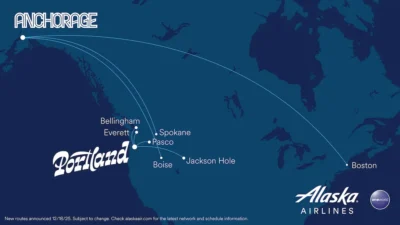
Alaska just announced seven new routes split between Anchorage and Portland, with service starting as early as March 2026 and ramping up into the summer peak. Tickets are already on sale via AlaskaAir.com
The Seven New Routes Alaska Just Announced
Alaska’s plan is simple: add lift where demand is loudest, and do it with schedules that make sense for the season. Here are the seven new city pairs and what we know right now, straight from Alaska’s rollout:
Anchorage – Boise: Starts June 10, 2026, ends Aug. 15, 2026, Wed/Sat, 737
Anchorage – Boston: Starts June 13, 2026, ends Aug. 15, 2026, Saturday, 737
Anchorage – Spokane: Starts June 10, 2026, ends Aug. 15, 2026, Wed/Sat, E175
Portland – Bellingham: Starts March 18, 2026, year-round, daily, E175
Portland – Everett (Paine Field): Starts June 10, 2026, year-round, daily, E175
Portland – Jackson Hole: Starts June 10, 2026, ends Sept. 30, 2026, Wed/Sat, E175
Portland – Pasco: Starts June 10, 2026, year-round, two times daily, E175
What I like about this batch is that it is not “random route dartboard.” It is targeted and very Alaska: summer-heavy leisure from Anchorage, and practical, connectivity-friendly Pacific Northwest flying from Portland. Increasing flights to Anchorage for the busy summer cruise season is an excellent bread and butter approach to increasing its presence in new markets especially like oneworld focus cities like Boston.
Anchorage Is Still The Summer Crown Jewel
Anchorage is the clearest proof point that Alaska is not abandoning its roots. The airline says it will fly Anchorage to seventeen nonstop destinations in the Lower 48 and Hawai‘i next summer, which it frames as the most it has ever offered in that peak season.
The headline grabber is obviously Anchorage to Boston. It is weekly, Saturday-only, and seasonal, which tells you exactly what it is: a summer pipeline aimed at feeding Alaska tourism and cruise traffic while giving New England a clean, nonstop option.
Anchorage to Boise is also new for Alaska, running twice weekly. Boise is not a “look at me” destination, but it is a fast-growing region with plenty of Alaska-connected demand, and it fits the airline’s habit of building these sensible spokes when it sees an underserved pocket.
Then there is Anchorage to Spokane, also twice weekly, and notably a route Alaska has not flown in ten years. This is the kind of add that screams “core market maintenance” rather than “international vanity project.”
Alaska also notes it is adding a second weekly nonstop for the summer season between Anchorage and both Sacramento and San Diego, citing strong demand. It is not part of the seven new routes list, but it reinforces the same theme: summer Alaska is still a priority.
Portland Keeps Turning Into A True Connection Engine
Portland’s four-route add is less about big geography and more about building a tighter web across the Pacific Northwest and beyond. Alaska positions PDX as a place where these flights unlock “convenient connections” to a network of more than sixty-five nonstop destinations, including Hawai‘i and Mexico.
The most interesting part is how “useful” these routes are:
Portland to Bellingham is daily and year-round, starting in mid-March. That is a very intentional move for a short-haul market, and it suggests Alaska sees consistent, everyday demand rather than just peak-season spikes.It also offers even more connectivity options against Allegiant.
Portland to Pasco gets two daily frequencies and year-round service. That is not a toe dip. That is Alaska trying to own the corridor and make the schedule commuter-friendly.
Portland to Everett (Paine Field) resumes daily year-round service. Paine Field’s “second Seattle airport” angle is baked right into Alaska’s framing, which is a polite way of saying PDX is continuing to play both offense and defense in the broader Northwest battle map.
And Portland to Jackson Hole is the classic summer leisure add: twice weekly, seasonal, and timed for the long summer stretch.
Alaska also slips in a telling operational note: when it resumes daily Portland to Fairbanks service in the summer, it will upgauge to a larger 737. Again, not flashy, but absolutely the kind of capacity decision that signals commitment.
The Bigger Point Alaska Is Making Right Now
It is easy to look at Alaska’s international headlines and assume the airline is about to “graduate” from its identity. But this announcement reads like a counterargument.
Alaska itself describes Anchorage and Portland as “essential” in its “growing global network,” and it also reiterates that it plans to serve Europe beginning in spring 2026. That is the balance: expand outward, but keep the home hubs healthy enough to feed everything else.
There is also a subtle confidence here. Airlines that are nervous about their core markets tend to retrench and simplify. Airlines that feel good about their base tend to add spokes that strengthen the web, even while they chase bigger strategic goals. Seven new routes is not a revolution. It is something more practical: Alaska tightening the bolts while it installs new wings.
Conclusion
Alaska’s international ambitions and the Hawaiian tie-up may be the storyline that gets the attention, but this latest move is the reminder that matters. The airline is still investing in Anchorage’s summer peak and Portland’s role as a Northwest connector, and the seven new routes are targeted, schedule-logical, and clearly built around demand rather than hype. If Alaska is going to pull off its next chapter, it will not be because it chased shiny objects. It will be because it kept its strongest foundations growing at the same time.