

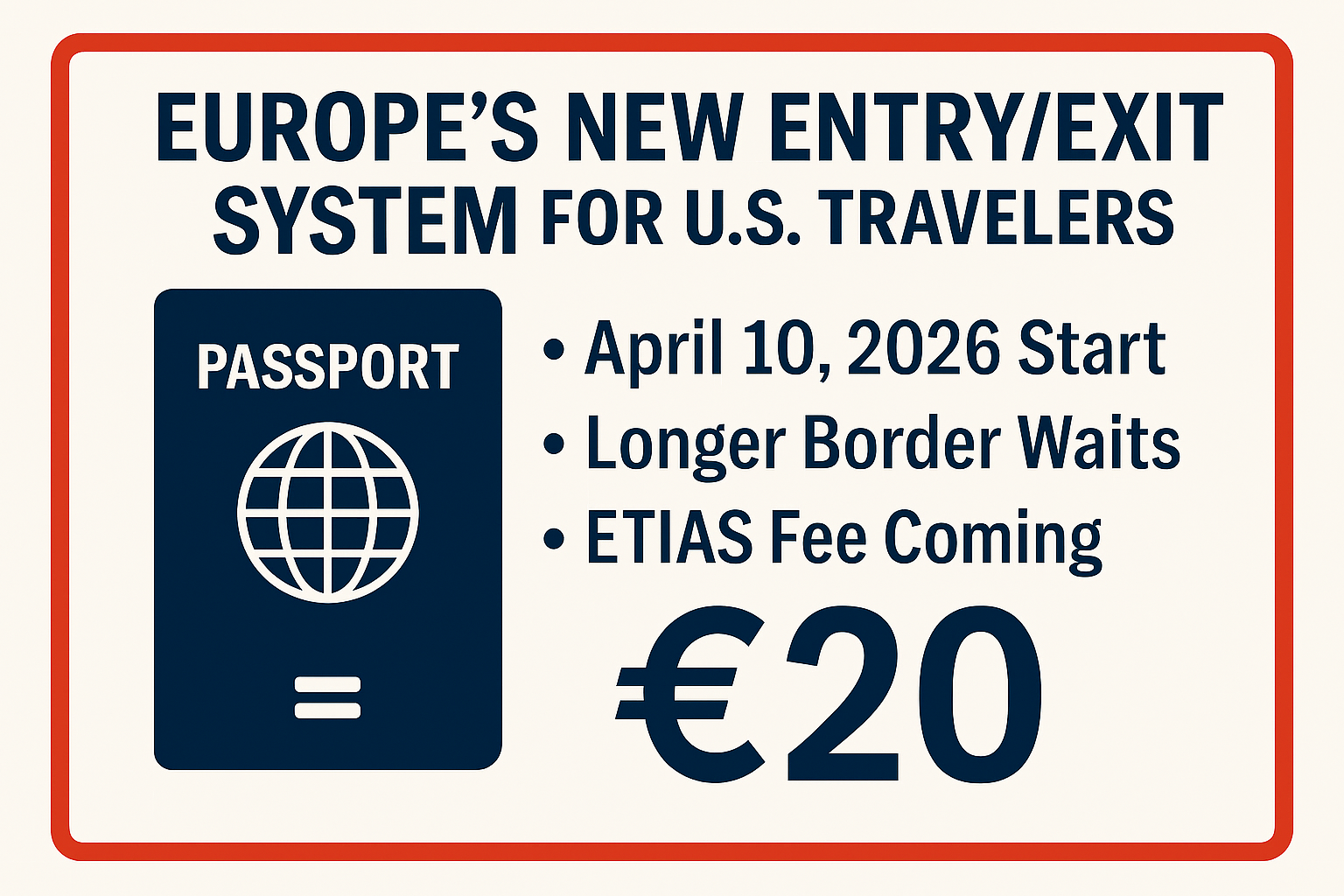
If you’re headed to Europe in the near future, your arrival and departure experience is about to change and not in the “priority passport lane magically appears” sort of way. As of April 10, 2026, the European Union’s long-delayed Entry/Exit System (EES)or European Travel Information and Authorization System (ETIAS) has now been fully implemented across the Schengen Zone. Today is the pilot phase, in a few months will also require payment aka a new tax on all travelers.
Europe Will Require More Data
Gone are the days where U.S. passport holders simply stroll up to immigration, receive a stamp, and head out in search of espresso or train connections to Florence.
Under the new system, all non-EU travelers, including Americans, Australian, Canadians, British etc visiting any of the 29 Schengen countries (France, Italy, Spain, Germany, Greece, Switzerland, the Nordics, etc.) for stays of up to 90 days in any 180-day period will now be required to:
- Submit fingerprints
- Undergo a facial scan
- Create a biometric travel record
This process will take place at self-service kiosks or staffed immigration checkpoints upon your first entry after implementation. The issue right now is many self-service kiosks are still not online. Meaning the staffed immigration check points lines are long!
While your biometric profile is then stored for three years, making future entries faster in theory, that first enrollment is going to take additional time and Europe’s airport infrastructure isn’t exactly known for peak-hour efficiency. Remember the long lines at airports last summer? Expect it again!
In other words: if your itinerary assumes you can land at 8:00am and comfortably make a 9:15am train to Brussels, you may want to rethink that. On my recent trip leaving the Azores the wait was often 90 minutes.
ETIAS Is Coming and It’s Not Free
Once EES is fully operational, the EU will move forward with its visa-waiver authorization program similar to the ETA for the UK or ESTA for the USA the European Travel Information and Authorization System (ETIAS), expected to launch in late 2026. My guess is October base on what we are seeing.
U.S. travelers will need to Apply online before departure Receive authorization linked to their passport and Pay a €20 fee (~$22 USD). Those who show up to the airport who have not pre-paid or pre-register risk being denied boarding.
Approval is expected to be relatively quick for most tourists and business travelers, but without it, you will be denied boarding. No different than how the U.S. denies boarding to inbound travelers without an ESTA.
I recall I once didn’t have my ETA for Australia. Back in the day before smart phones. Thankfully SFO had computers travelers could rent by the minute. My Australia ETA was approved in about 10 minutes and I still made my flight. Yet since then, I always check out travel.state.gov before ANY trip.
For the E.U. travelers will not have to do this for EVERY trip, but instead just every three years, or until passport expiration, whichever comes first
Bottom Line
EES won’t prevent you from visiting Europe, but it will make your first arrival slower and possibly your first departure as well, depending on when you entered the E.U. ETIAS will soon make your trip modestly more expensive, or at least more expensive every three years.
If you’re planning travel to Europe in late 2026 or beyond, you’ll want to Apply for ETIAS ahead of time, allow extra time at immigration on arrival, Avoid tight same-day train or flight connections after landing. The worst thing that could happen is a long line makes you miss a flight or train connection.
More fees and more hoops are coming to travelers to the EU. Be sure to prepare accordingly and pay your fees in advance of your next trip to Europe. Fees will kick in come October through December 2026.