• Skip to primary navigation
  • Skip to main content
  • Skip to primary sidebar
  • Privacy Policy
  • Contact Us
  • Travel Questions
Travel Codex

Travel Codex

Your Resource for Better Travel

  • Subscribe
  • Credit Cards
  • Reviews
  • Guides & Tips
  • Award Travel

Review: Asiana Business Class, Los Angeles to Seoul

by Scott Mackenzie
Last updated June 16, 2026

My wife and I have flown Asiana’s old, angled lie-flat business class several times out of Seattle, which was tolerable for its convenience but not very pleasant. A year ago I switched to the A380 out of Los Angeles for a first-class trip to Siem Reap. (Here’s Omar’s review of a similar Asiana first class flight in the other direction.) Both first and business class space on this route are abundant, and I have United Airlines miles to burn.

On this trip we were heading to Shanghai, Kyoto, and the big island of Hawaii — just going where the award space took us, and checking off a few items on our bucket list. I’ll add a trip report index once finished.
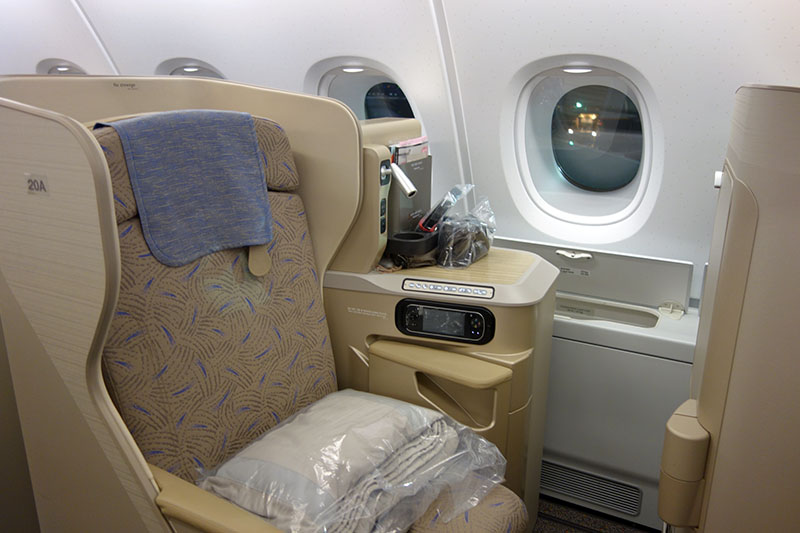
a seat in an airplane
Seats on the window side have the most privacy and storage, but we were seated together in the middle.

Tickets for the first leg cost 80,000 United miles and $14.50 in taxes and fees per person, which I consider reasonable for such a consistent option to reach Asia. It’s not as refined as Cathay Pacific or Singapore Airlines, but Asiana still has better service and food than most carriers. There are both morning and red-eye flights available on this route. We took the morning flight last time, and it was completely impossible for me to get any sleep. This time we left just after midnight.

OZ 203

  • Departing from Los Angeles (LAX) at 12:20 AM
  • Arriving at Seoul-Incheon (ICN) at 5:10 AM + 1 day

Check In

The downside to flying out of LAX, besides the congestion, is that I usually end up booking a separate one-way positioning flight on Alaska Airlines. I left just under three hours to connect since I was worried about potential delays and was unsure about the security requirements when changing terminals.

There is an underground tunnel connecting terminals 8 through 4 at LAX (Alaska flies out of T6), with a bridge connecting T4 to the Tom Bradley International Terminal. James has discussed this before. Because we always carry on, we just walked to the Star Alliance business class lounge at TBIT and found an Asiana agent there able to issue boarding passes without re-clearing security. Just show your itinerary to the agent at the entrance and they’ll waive you in.

Related Posts

  • Changing Terminals at Los Angeles International Airport
  • Review of Star Alliance Business Class Lounge at LAX

We arrived at our flight just a few minutes before boarding and made it to our seats. Although I’ve heard they have upgraded the Seattle flights to a true lie-flat option, I was still glad to fly on the A380 again to compare it directly to my previous trip in first class.

Seat Configuration

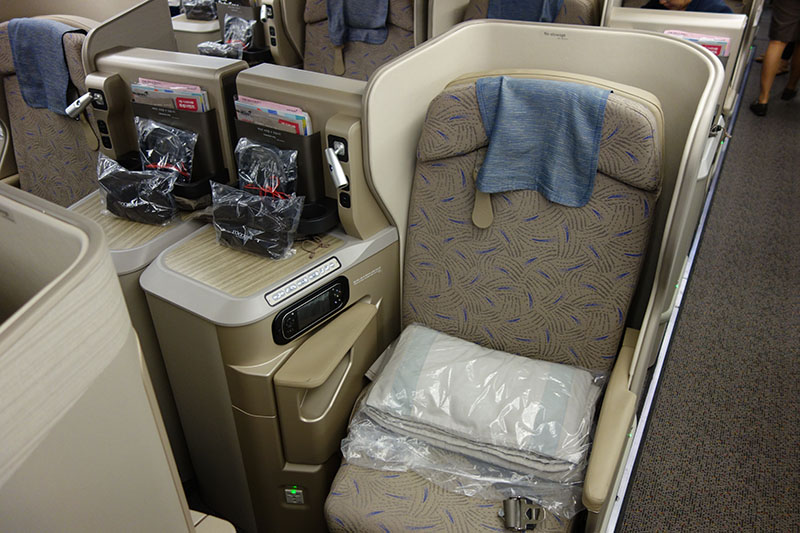
Asiana’s Business Smartium Class (that’s really what it’s called) consists of a 1-2-1 configuration along the first two thirds of the upper deck. Premium economy was behind us, and first class and regular economy were on the lower deck. A sitting room located at front of the upper deck doesn’t offer any real amenities, and, as on our previous flight, it was only used by parents with infants. The one feature is the lavatory on the left side, which is very spacious if you need a place to change clothes at the start or end of the trip.
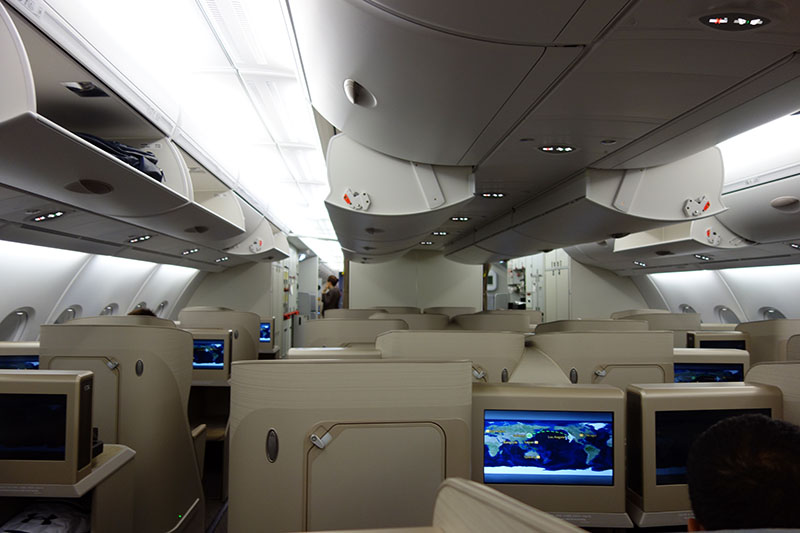
an airplane with a television and seats

a seat with a towel and a towel on it
There is a lot of space between adjacent passengers, but almost no privacy from the aisle. Alternating rows have the opposite problem.

We settled into seats 19D and 19F. I specifically requested these to get away from the galley and was warned twice that they were not suitable for a couple because the arm rests were in the middle, separating the seats. The seats do offer plenty of privacy from the person sitting next to you, but my wife and I were able to converse just fine when necessary.
a person sitting in a chair in an airplane
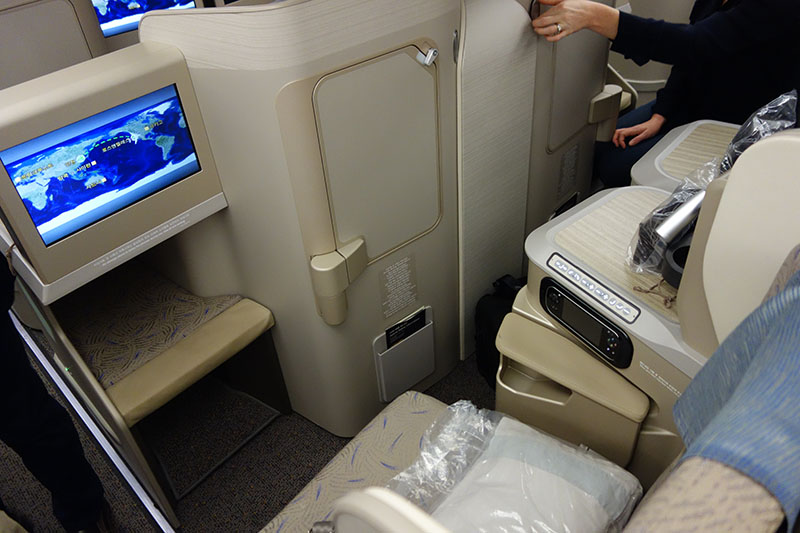
The table flips down from the center divider and is not very easy to adjust (other than rotating it toward you).

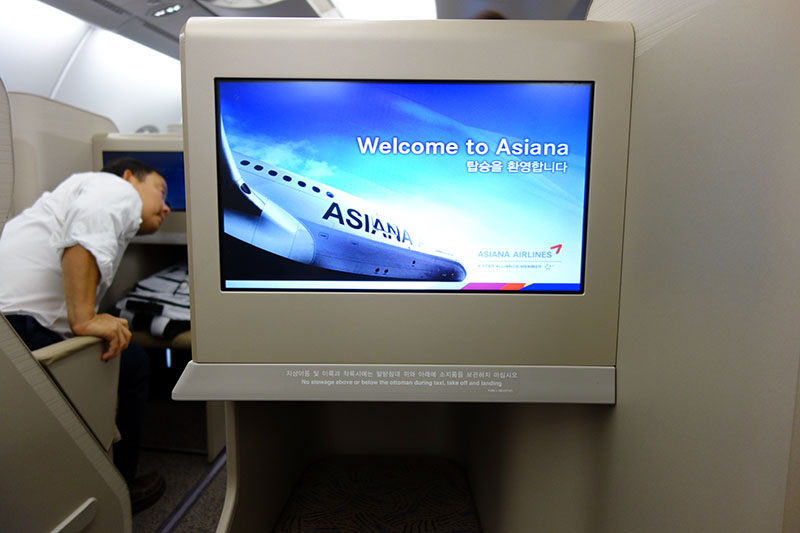
Business Smartium offers a large flat screen display (although first class has a whopping 32-inch screen) and a spacious footwell, which are all I really need to get comfortable on a long flight. I’m about 6’1” and didn’t feel constrained at all when sleeping. The cabin does get warm, so I dressed appropriately, and leaving late at night helped a lot.
a screen on a wall
This picture makes the screen seem smaller than it actually is. I was satisfied.

a close up of a device

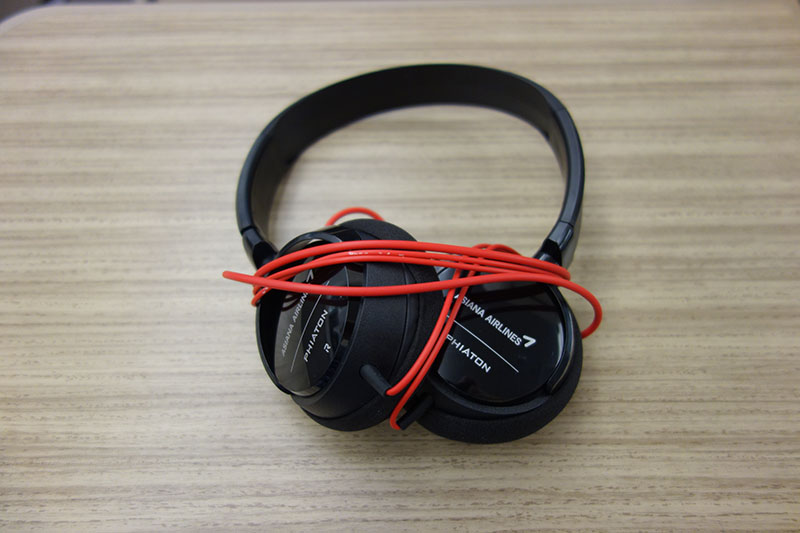
a pair of black headphones with red wire
The headset was disappointing. So many carriers today are offering noise-cancelling headphones from Bose or similar manufacturers. A flimsy headset is just not a good way to spend a long flight.

Unfortunately, there’s no storage beneath the footwell. I had to keep my bag in the bin above me and reach up there every time I wanted something. I kept my spectacles and a few other things in the small open cubby above the center arm rest.
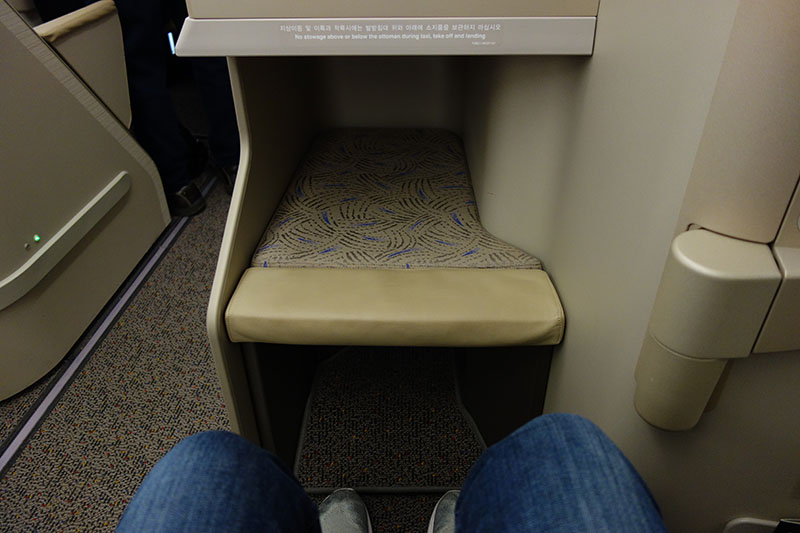
a seat in a chair

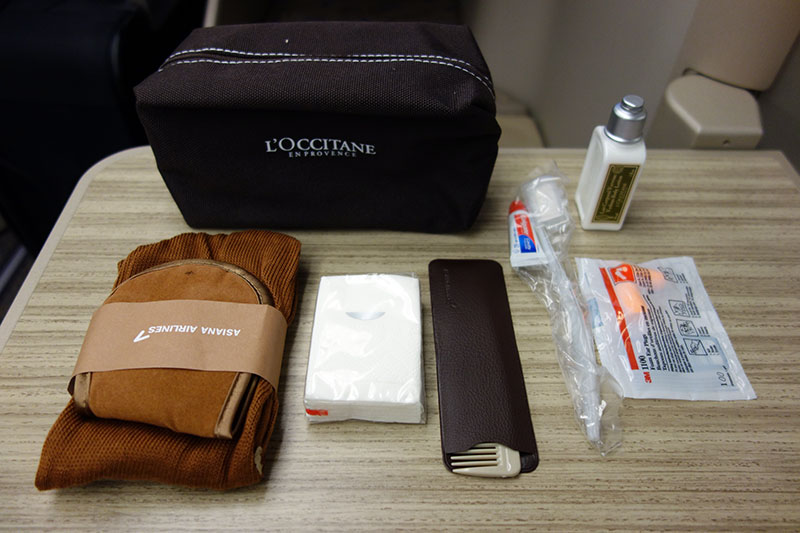
a small black bag with items on it

The amenity kit has all the basics, including a toothbrush, hand lotion, eye mask, socks, and tissues. Shaving kits are in the lavatory. I was disappointed by the noise-canceling headphones, which were somewhat flimsy, but the set I got later on JAL was even worse. Point is, if this is something that matters to you then you should really invest in your own pair and travel with them. I usually travel with my own eye mask for the same reason.

Meal Service

I usually pick the Western meal on flights to Asia, though I try to avoid the beef since so many carriers make it tough and unpalatable.

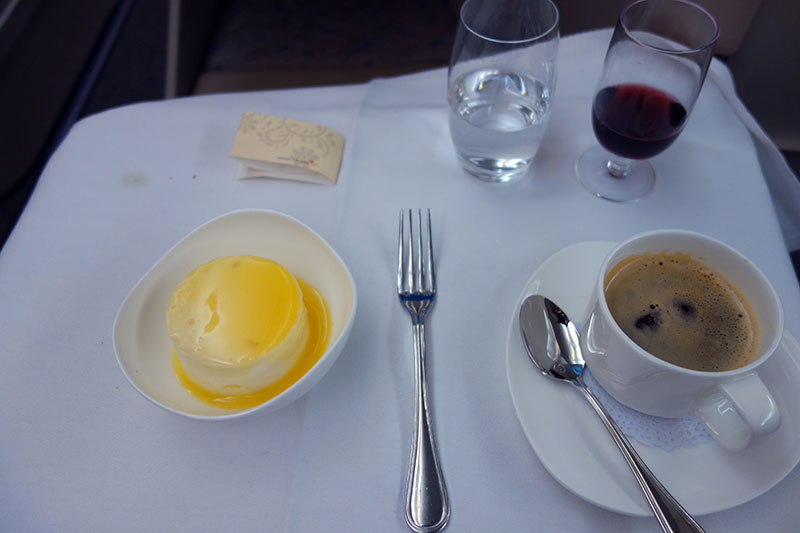
I’m not sure what I expected when I ordered the chicken with puff pastry — maybe it would just be placed on top or to the side? — but what I got was closer to a chicken pot pie. That turned out to be perfect. It tasted good and wasn’t too large a portion for a late night flight. Desert was a simple mango cheesecake (and a little less impressive).
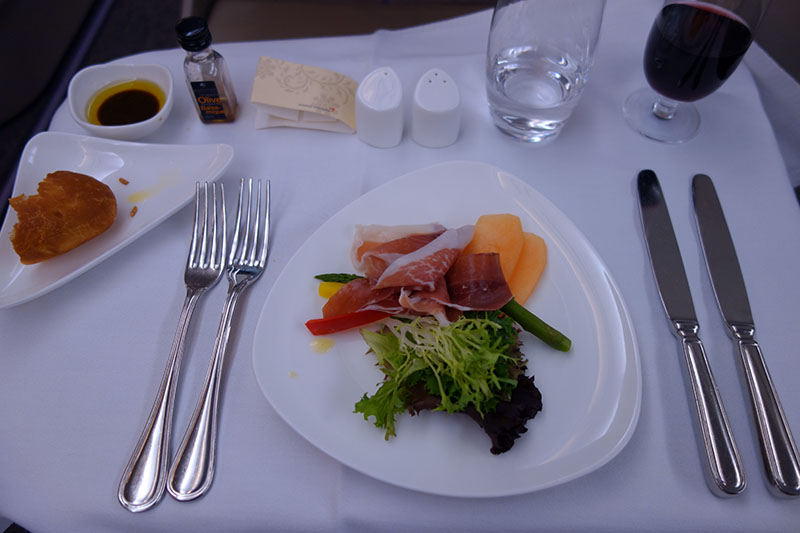
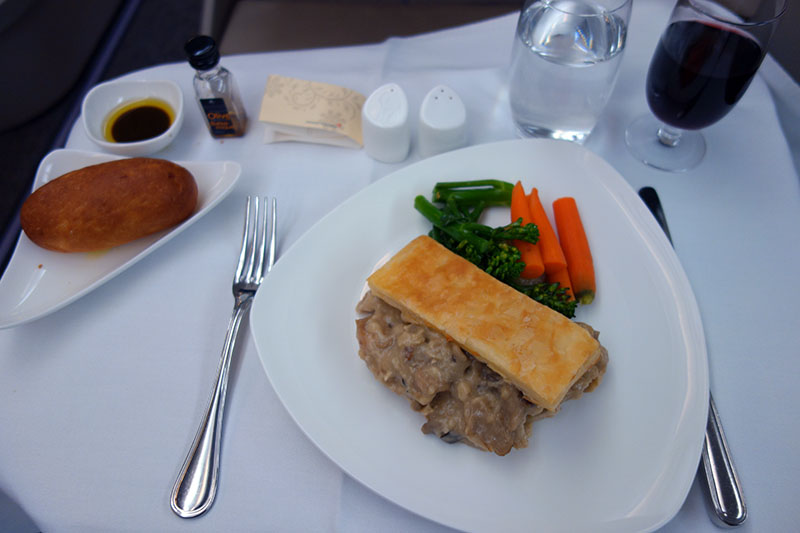
a plate of food on a table

a plate of food on a table

a plate of food and a fork on a table

The Korean meal is almost always bibimbap if you’re interested in being more adventurous. Megan’s had it so often that it’s what she looks forward to when she hears we’re taking another trip on Asiana.

Some of the less common alcoholic beverages included:

  • Sandeman Sherry Medium Dry
  • Chivas Regal 18 Scotch Whisky
  • Ballantine’s 17 Scotch Whisky
  • Camus XO Cognac
  • Korean Rice Wine “Makegolli”
  • Korean Traditional Grain Wine “Hansan Sogokju”
  • OB, Cass, Hite, and Max beers

The wine list included:

  • Laurent Perrier Brut Champagne
  • Aaldering Sauvignon Blanc 2015
  • Champy Bourgogne Chardonnay 2014
  • Chateau Cissac 2012, 2014
  • Noble Vines 667 Pinot Noir 2014
  • Codillera Syrah 2012

I had the pinot and was happy. Megan went with the Chateau Cissac. Personally, I find French wines are too delicate to taste like much in the dry air at altitude. Whether that was the reason or not, Megan agreed that she also liked my pinot better and switched halfway through her meal.

I finished my movie with a glass of Ballantine’s and slept for a good six hours before waking up over Japan. The flight attendant quickly noticed I was alert and brought over a coffee before starting the breakfast service about an hour later. That included a substantial fruit plate, pastries, and an omelet with sausage, potatoes, and spinach. I also saw yogurt on the menu and on some tables, but I guess you have to request it.
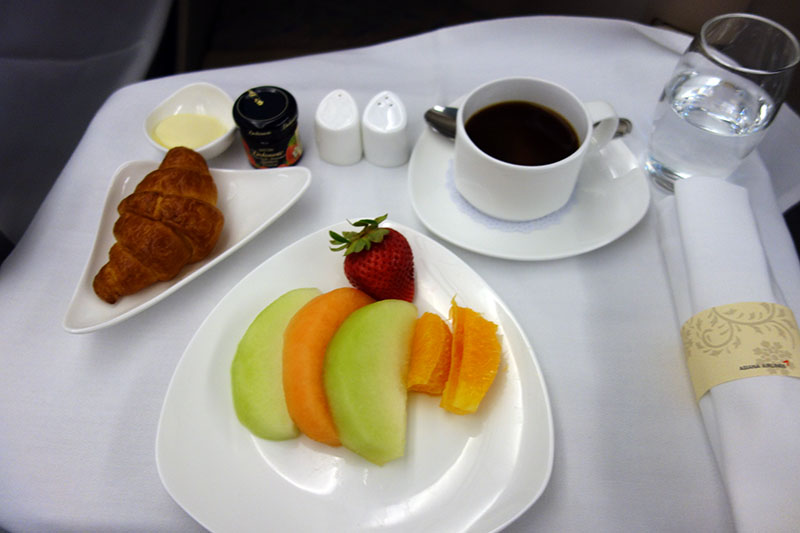
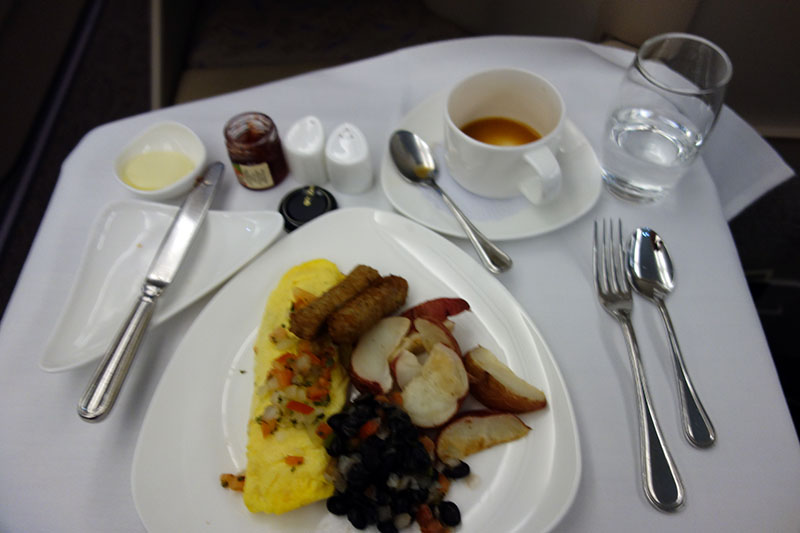
a plate of fruit and a croissant on a table

a plate of food on a table

Entertainment options were plentiful enough. I have never run out of movies to watch on an Asiana flight, although it is annoying that they switch to a silly film on stretching exercises at 30 minutes before landing. I’d prefer to watch my own show from gate to gate.

Summary

My wife and I were pleased with our business class flight to Seoul on Asiana. It was much better than our previous trips out of Seattle in their older business class seat, and the experience was on par with my last trip in first class. I wasn’t overly impressed with Asiana’s first class and don’t value the uber-privacy of an enclosed suite. Business class was definitely the way to go and cost much less.

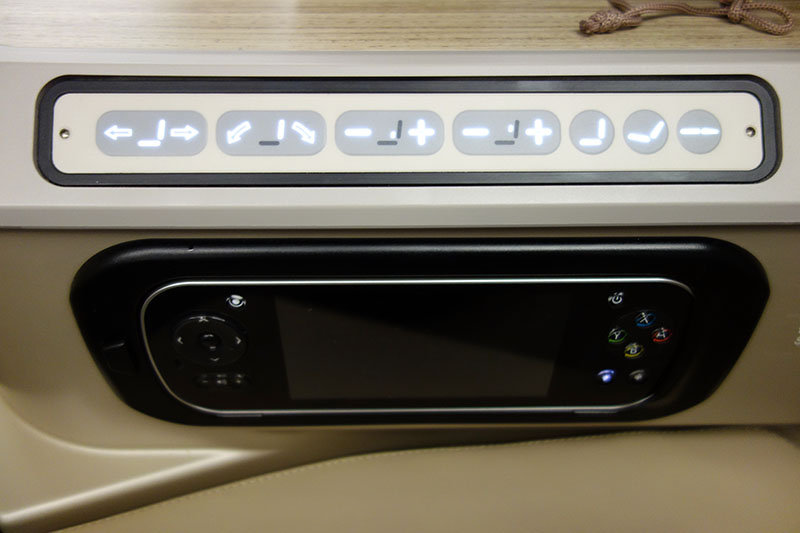
But, I would make an effort next time to change my seat assignment. The large side table provided privacy from the passenger next to me (my wife) and left me very exposed to the aisle. The arm rest actually goes all the way down when the bed is reclined in sleep mode, and there’s no way to bring it up manually. That means I was essentially sleeping inches from the aisle. On the other hand, if you are next to another passenger who isn’t your spouse, you’ll be inches away from playing footsie.
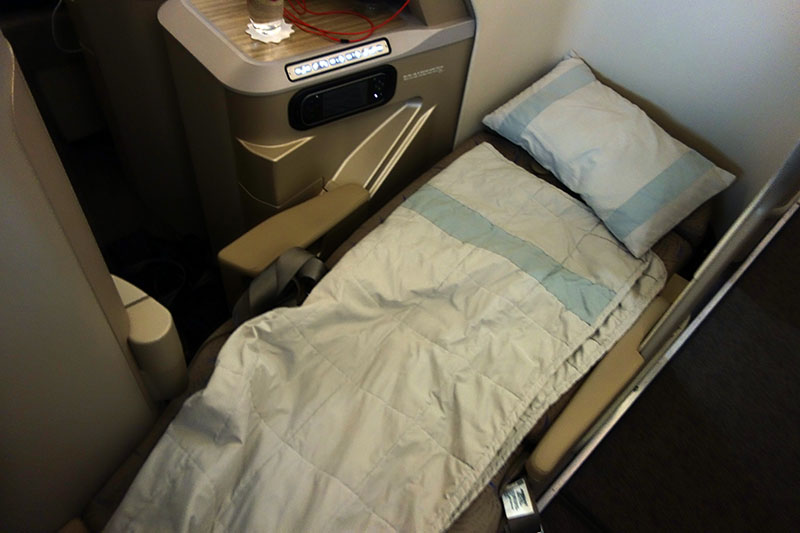
a bed in a plane

It seems you have to choose one extreme or the other in the middle seats. Fortunately, Business Smartium does provide an excellent option for those sitting along the window, with privacy from the large side table and the addition of extra storage cubbies along the window.

Asiana Business Class At a Glance: Key Specs

Asiana’s long-haul business class product goes by the name Business Smartium, and the headline numbers hold up well against comparable products in the Star Alliance network. Every seat on the long-haul fleet reclines to a fully flat 180-degree bed with direct aisle access for every passenger. The table below covers the essentials for anyone deciding whether to book.

Spec Detail
Product name Business Smartium
Alliance Star Alliance (through December 16, 2026)
Cabin layout 1-2-1 staggered (A380, A350-900, Boeing 777-200ER)
Seat type Fully lie-flat, 180 degrees; no enclosed privacy door
Bed length Up to 77 inches (195.5 cm) on the A350-900; the Boeing 777-200ER is slightly shorter (roughly 74 to 76 inches)
Aisle access Direct from every seat
Wi-Fi A350-900: yes. A380 and Boeing 777: not available
A380 Business Suites 12 former First Class private suites with closing doors, sold as an upgraded business tier
Best aircraft for business class A350-900 (modern cabin, Wi-Fi); A380 upper deck (quiet, spacious)

The A380, A350, and Boeing 777: Which Aircraft Has The Best Business Class?

Asiana operates Business Smartium on three long-haul aircraft types, and the experience differs meaningfully between them. Knowing which aircraft is scheduled for a given flight is worth checking before booking.

Airbus A350-900: The Modern Pick

The A350-900 is widely regarded as the strongest all-around option in Asiana’s fleet for business class travelers. The aircraft’s cabin offers higher humidity levels that reduce the fatigue common on long overnight flights, and it is the only Asiana long-haul type with in-flight Wi-Fi. The Business Smartium seats follow the same 1-2-1 layout found across the fleet, with every passenger having direct aisle access. Asiana’s US routes from San Francisco (SFO) and New York (JFK) to Seoul-Incheon are currently served by the A350.

Airbus A380: The Upper-Deck Experience

The A380 offers its own appeal, particularly for passengers who book the upper deck. Business Smartium occupies the forward two-thirds of the upper deck in a 1-2-1 layout, with Premium Economy behind it. The upper deck is noticeably quieter than main-deck cabins on any aircraft, and the enclosed upper-deck environment gives the flight a more intimate feel. What the A380 lacks is Wi-Fi, which is a real consideration on a 10-plus-hour transpacific segment.

The A380 also carries a separate product at the front: 12 former First Class private suites, now sold as Business Suites. These retain the enclosed-door hardware of the original First Class cabin but are priced and staffed as a premium business-class tier, not a true First Class. For passengers who want maximum privacy on the A380, the Business Suites are worth checking against the Business Smartium fare difference. The LAX-ICN route is the primary US market where the A380 operates.

Boeing 777-200ER: Solid but No Wi-Fi

The 777-200ER carries Business Smartium in the same 1-2-1 lie-flat configuration. It is a fully capable long-haul product, though like the A380 it does not have Wi-Fi. Travelers who are indifferent to connectivity and are comparing schedules will find the product broadly consistent with the A350 experience in terms of seat comfort and layout.

One aircraft to be aware of on shorter regional routes is the A330, which has an older angled-flat seat rather than a fully lie-flat Business Smartium product. For long-haul transpacific travel, the A380, A350, and 777 are the relevant fleet options.

How to Book Asiana Business Class With Miles

Asiana is a Star Alliance member, which means a wide range of loyalty programs can book award seats on its flights. The programs with historically strong value for Asiana business class redemptions include ANA Mileage Club, Avianca LifeMiles, and Air Canada Aeroplan. United MileagePlus is also a straightforward option, though United moved to fully dynamic partner award pricing, so the miles required will vary based on the specific route and date.

ANA Mileage Club has offered round-trip business class between North America and South Korea for around 130,000 miles. Avianca LifeMiles has priced the same redemption from around 75,000 miles one-way with no fuel surcharges, though some North America-to-Korea city pairs now price higher after a 2025 chart adjustment, and Air Canada Aeroplan uses distance-based pricing that lands in the 75,000-to-115,000 mile range one-way depending on the origin and fare availability. Miles transfer into ANA from American Express Membership Rewards; LifeMiles accepts transfers from American Express, Citi, Capital One, and others; Aeroplan accepts Chase, Amex, Capital One, and more.

One timing consideration stands out for 2026: December 1, 2026 is the last day to book new Star Alliance partner awards using Asiana Club miles. After that date, Asiana Club’s Star Alliance partner redemption access closes as part of the Korean Air integration. If you hold Asiana Club miles and want to use them on United, Lufthansa, ANA, or other Star Alliance carriers, book before that cutoff. Award rates and availability change frequently, so verify current pricing directly with each program before redeeming.

For a broader look at how to get to Seoul using points, the site’s guide on booking Korean Air with SKYPASS covers the SkyTeam side of the equation, which becomes the relevant path once Asiana is fully integrated into Korean Air.

Asiana Business Class vs. Korean Air: How Do They Compare?

The question of Asiana versus Korean Air comes up constantly, and it matters more in 2026 than it did even a year ago given the merger timeline. The short answer: both are good products, and the right choice depends on which aircraft and which priorities matter to a given traveler.

Asiana’s Business Smartium gives every passenger direct aisle access in a 1-2-1 configuration, which Korean Air’s current Prestige Class does not always match depending on the aircraft. Korean Air’s newer Prestige Suites 2.0, found on its A350-900 and 777-300ER fleet, are a genuinely strong product and have drawn favorable comparisons to top-tier business class globally. On food, Korean Air is frequently cited for culinary quality, including Korean rice bowl service that passengers tend to remember. Asiana’s meal service is solid and includes both Korean and Western options, though recent traveler accounts suggest Asiana has been less consistent than Korean Air on this front in recent years.

The lounge experience at Seoul-Incheon differs as well. The Asiana Business Class Lounge at Incheon Terminal 1 is a quieter, more compact space with a focus on Korean traditional cuisine. Korean Air’s lounges in Terminal 2 are larger with more amenities. Practically speaking, after December 17, 2026, Asiana passengers will transition to Korean Air lounges anyway, so the distinction becomes temporary. If Asiana’s Business Smartium seat on the A350 appeals, fly it before the end of 2026. If Korean Air’s newer hard product is the priority and schedule works, that is also a strong choice. Asiana business class on a shorter intra-Asia hop is covered separately for travelers who want to experience the product on a regional segment first.

The Korean Air Merger: What It Means for Asiana Travelers

The Korean Air acquisition of Asiana Airlines has been in motion since 2020, and 2026 is when it reaches its conclusion. Korean Air has set December 17, 2026 as the full integration date, at which point the Asiana brand, logo, and operating license are retired. All flights will be consolidated under the Korean Air name, and Asiana will exit Star Alliance and join Korean Air’s alliance, SkyTeam, on that date.

For travelers, the practical implications break into a few areas. First, the product: Asiana Business Smartium flights are still operating normally through the end of 2026, and awards can be booked on Asiana-coded flights during that period. Second, loyalty: Asiana Club miles will convert to Korean Air SKYPASS, with flight-earned miles converting at a 1:1 rate and partner-earned miles (from hotels and credit cards) at approximately a 0.82:1 rate. Third, status: Asiana elite tier holders will see their status converted to SKYPASS tiers, and the partner benefit network will shift from Star Alliance carriers to SkyTeam carriers including Delta, Air France, and KLM.

The clearest action item for 2026 is to book and complete any Asiana award travel, and any Star Alliance partner awards redeemed with Asiana Club miles, before the December deadlines. The Business Smartium product is worth flying on its own merits. The merger simply adds a time limit to that opportunity.

Frequently Asked Questions

Does Asiana Have Lie-Flat Seats in Business Class?

Yes. All Business Smartium seats on Asiana’s long-haul aircraft (A380, A350-900, and Boeing 777-200ER) recline to a 180-degree fully flat bed measuring up to 77 inches in length on the A350-900, with the Boeing 777-200ER bed running slightly shorter at roughly 74 to 76 inches. Every seat in the 1-2-1 cabin layout has direct aisle access, so no passenger has to climb over a neighbor. Note that Asiana’s A330, used on some regional routes, has an older angled-flat seat that does not lie fully flat.

What Is Asiana Business Smartium Class?

Business Smartium is the branded name for Asiana’s long-haul business class product. It refers specifically to the staggered 1-2-1 lie-flat seat configuration found on the A380, A350-900, and Boeing 777. The name is meant to distinguish this fully lie-flat product from older or regional seat types, and travelers may also see it branded as Quadra Smartium on some aircraft. On the A380, there is a separate premium tier called Business Suites, which consists of 12 former First Class private cabins with closing doors, sold as an upgraded business class fare.

Which Asiana Aircraft Has The Best Business Class?

The A350-900 is widely considered the strongest choice for the complete experience. It has a modern cabin with higher humidity, the same 1-2-1 lie-flat Business Smartium layout as the other long-haul types, and is the only Asiana long-haul aircraft with in-flight Wi-Fi. The A380 upper deck is a close second for passengers who prioritize a quiet, spacious cabin atmosphere, and its Business Suites offer the only fully private suite experience on Asiana. The Boeing 777 provides the same Business Smartium product but without Wi-Fi.

How Do You Book Asiana Business Class With Miles?

Asiana is part of Star Alliance (through December 16, 2026), so any Star Alliance currency can be used to book award seats on Asiana flights. Programs with published or historically competitive rates for Asiana business class include ANA Mileage Club, Avianca LifeMiles, and Air Canada Aeroplan. United MileagePlus uses dynamic pricing, so the miles required vary. Check current availability and pricing directly with each program, as award rates change. Be aware that December 1, 2026 is the last day to book new Star Alliance partner awards using Asiana Club miles specifically.

Is Asiana Business Class Worth It?

For most long-haul travelers to South Korea and beyond, yes. The Business Smartium product delivers a fully lie-flat bed with direct aisle access from every seat, warm and attentive Korean service, and a solid food and beverage program that includes Korean menu options alongside Western choices. What it does not offer is an enclosed privacy door or suite, which matters to some travelers more than others. On the value side, Asiana has historically represented strong worth in the mid-tier of premium Star Alliance products, particularly when booked with transferable points through programs like ANA Mileage Club or Avianca LifeMiles. The 2026 caveat: the Asiana brand retires at the end of the year, so this particular product is on a definitive clock.

What Happens to Asiana Business Class After The Korean Air Merger?

The Asiana brand is fully absorbed into Korean Air on December 17, 2026. After that date, there are no more Asiana-coded flights, and the Business Smartium product as a distinct offering ceases to exist. Asiana aircraft and routes will continue operating under the Korean Air brand, transitioning to Korean Air’s Prestige Class product over time. Asiana Club miles convert to Korean Air SKYPASS, and Star Alliance benefits are replaced by SkyTeam benefits. Travelers who want to fly the Asiana Business Smartium experience specifically need to book and complete travel before the end of 2026.

Read This Next

  • Review: Asiana Business Class Manila to Seoul
  • Review: Asiana Business Class Lounge Seoul
  • Review: Asiana Business Class, Seoul to Shanghai-Pudong

About Scott Mackenzie

Scott is a former scientist and business student who created Travel Codex to unravel the complexity of travel loyalty programs. After 11 years in Seattle, he now lives in Austin with his wife and flies over 100,000 miles every year.

Primary Sidebar

Over 100K+ Followers

Subscribe to updates from Travel Codex

none

Learn to how to find the cheapest awards.

Search Now

none

Transfer points to get more value.

See Options

none

Compare credit cards to earn more miles.

Explore Offers

Contact

If you have a question or would like to make a press inquiry, please contact:

Kyle Stewart
Editor in Chief
Email Him

For updates:
Subscribe to RSS
Subscribe to Apple News

Privacy Policy


© Travel Codex, LLC All Rights Reserved.


Unauthorized use and/or duplication of this material without express and written permission from this site’s author and/or owner is strictly prohibited. Excerpts and links may be used, provided that full and clear credit is given to Travel Codex with appropriate and specific directions to the original content.